


For whalers, letters were among the most prized objects they had on their person. Nothing plunged a fellow into greater despair than coming into port after months at sea and receiving no letters, and nothing seemed to make him happier than when a letter did arrive (that is, if it brought good news). Old letters were clung to, sometimes from seasons’ past. As the only tangible anchor to a life and loved ones left ashore, they’d be read over and over again.
“Oh dear it makes me Home Sick and I have to read my letters over again for the 7000th time",” pined Benjamin Boodry, 2nd Mate of the Arnolda 1852-55.
How whalers got letters, however, was through a winding unreliable process that was left mostly up to chance. Since whaleships traveled the globe for years people at home would have no advance knowledge of their ‘itinerary’. They would simply write a letter to someone, address it to them, their ship, and ‘the Pacific Ocean’ and hope for the best.
At well trafficked whaling ports, ships going to and from home would intersect. They would often exchange letters between each other, or leave them off with an official ashore (ranging from a post office to a chaplain) to be held onto in case the person it was addressed to found themselves there. It wasn’t a guarantee that they would ever find their intended though. Mr. Boodry kept count of how many letters were sent, and how many received.
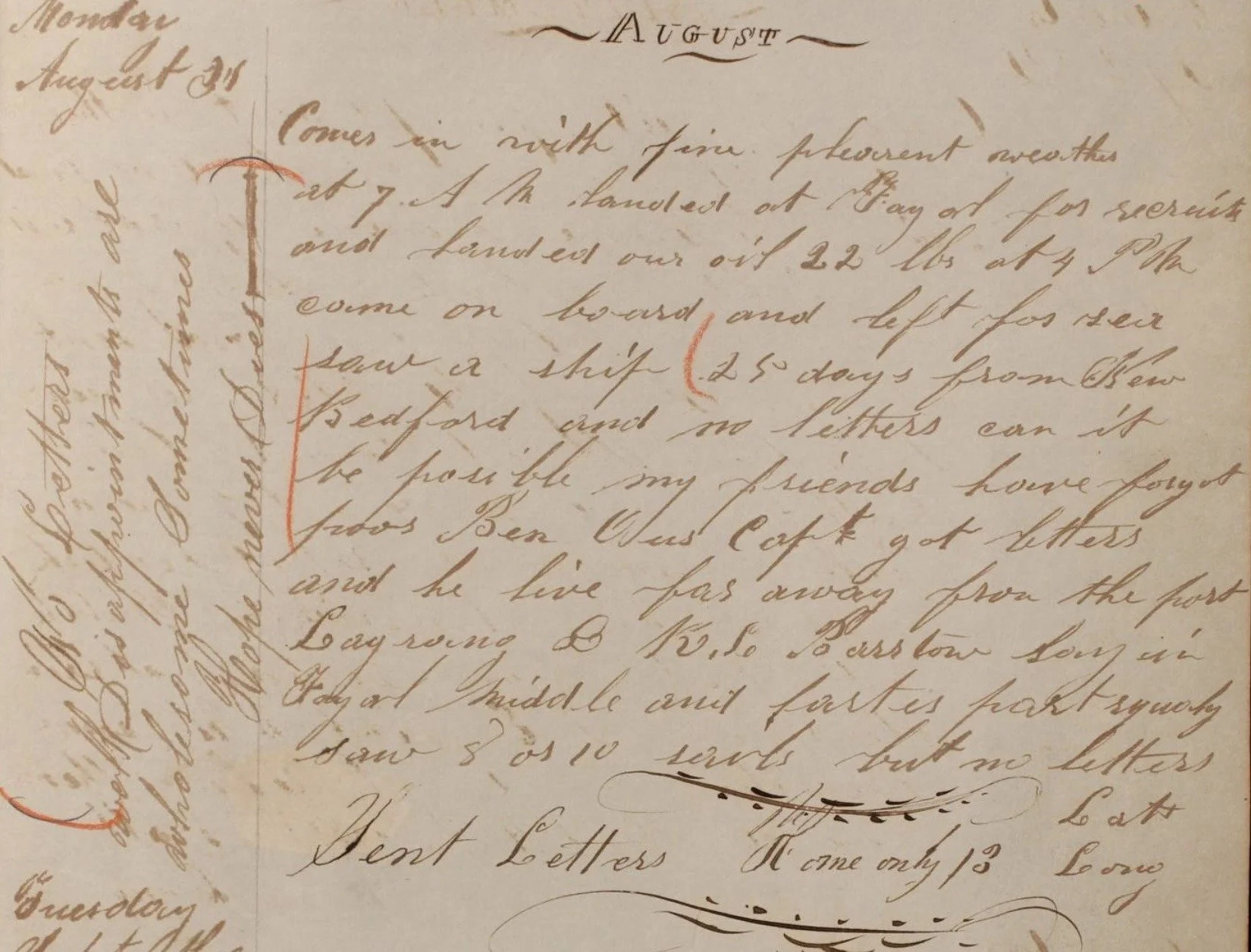
“August 31st
Comes in with fair pleasent weather at 7 AM landed at Fayal for recruits and landed our oil 22 bbs at 4 PM come on board and left for sea saw a ship 25 days from New Bedford and no letters [.] can it be possible that my friends home forgot poor Ben Our Capt got letters and he live far away from the post[.] Lagrange & R.L Barstow lay in Fayal middle and larter part squaly saw 8 or 10 sails but no letters
Sent Letters Home only 13
[in the margin:] No Letters
well Disappointments are
wholesome Sometimes
Hope never Dies—”
Silliman Ives of the Sunbeam 1870 expressed similar disappointment when he was the only one on board who did not have a letter waiting for him in port.
“Between you, and I, and the mainmast, I am disgusted and disappointed. What an outrageous country this is, where one must needs wait a year or more for news from home, and then, after waiting patiently for that length of time, it ain’t no two for one that you’ll get a letter. Now I wrote to my friends last Sept. and I’m still waiting a reply and it looks very much as though I might take it out in waiting. Yesterday we went into Kema for our mail, and I am the only one aft who is letterless. Now such a state of things isn’t very pleasant to contemplate, and when one sees all of his shipmates eagerly devouring the contents of a home or sweet hearts letter, such a vision does not tend to make one feel particularly sweet tempered. But I suppose growling won’t mend the matter any, and if I should growl from this until the close of the voyage it wouldn’t hurry up my mail, or add to the number of my letters. So I will take my disappointment as philosophically as I can and hope for a letter fortune next time.”
In the case of Mr. Boodry, fortunately, the letters written by his loved ones eventually found their way to him. Still, they provided only a meagre comfort when home felt so far away,
“have got the whole 25 of them by last and want some more [,] only got one from Rochester Centre 24 from Mattapoisett 8 of them from Helen do not think that I can grumble at her neglect if she continues in that way [.] I wish I was there to hang her a May Basket [.] I believe I should get into a 2 bushel basket and hang myself if she would take me in [.] here I set in my state room the door shut and my whole family of Daguerreotypes around me and my Accordion in my hand and I try to imagine myself in old Mattapoisett but it is far from the reality”
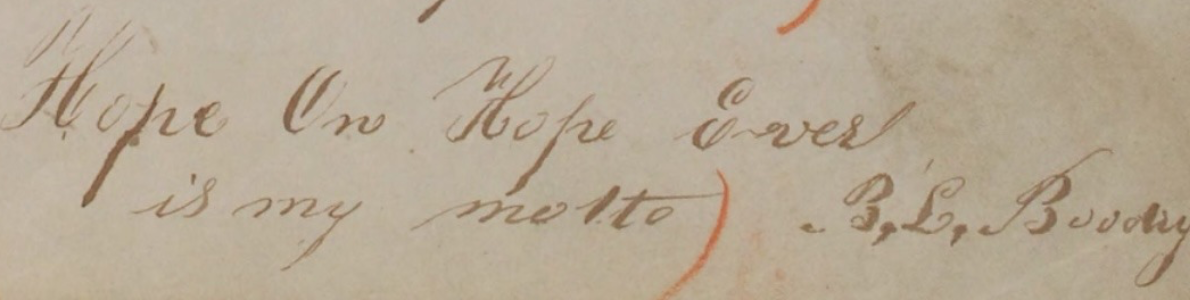
Hope on Hope Ever is my motto - B.L. Boodry
In addition to ports, letters were often exchanged when whaleships came across one another at sea. Whaleships were unique to other vessels in that they tended to spend an extended time socializing when they met (rather than a simple exchange of signals or words). As discussed in a previous essay, ships would exchange crews and spend the night entertaining each other, trading provisions, getting news, etc. During these times the ships would exchange newspapers and letters they had been carrying in the hopes that there were ones addressed to each other, or to be brought home or to another port where the other whaleship would be sailing.
Thomas Nickerson, cabin boy of the ill-fated whaleship Essex, wrote about the excitement of receiving letters from another whaleship in his personal account:
“They had brought us plenty of letters and some newspapers, a rich treat truly. After the captain and officers had selected theirs the mailbag was sent forward for the crew to overhaul and pick for themselves […] Who can but realize how much we enjoyed who found a letter in the package, or the disappointment of those who had none.
It was amusing to watch those of our lads who had been disappointed and found no letters for them. They would follow us around the decks and whilst we were reading our letters would seat themselves beside us as though our letters could be of service to them or convey news from their own friends. But as our family letters could be of no interest to them, they were compell’d to seek for news in the careless folds of a newspaper.”
There were even instances of lonely whalers who didn’t receive a letter buying another shipmate’s to pretend it was for them. This was documented by scholar Margaret Creighton, who found in the journal of Ezra Goodnough of the Ann Parry:
“I sold a letter that I received from a young lady of Salem and the only one to that I have received this voyage for two heads of tobacco, it being a very scarce article.”
Those ashore would also mostly learn of where their whaling friends and family were from the ‘careless folds of a newspaper’. Newspapers listed when ships arrived in town with letters they accumulated from other ships and port mailrooms, so folks could see if any letters were written to them from sea.
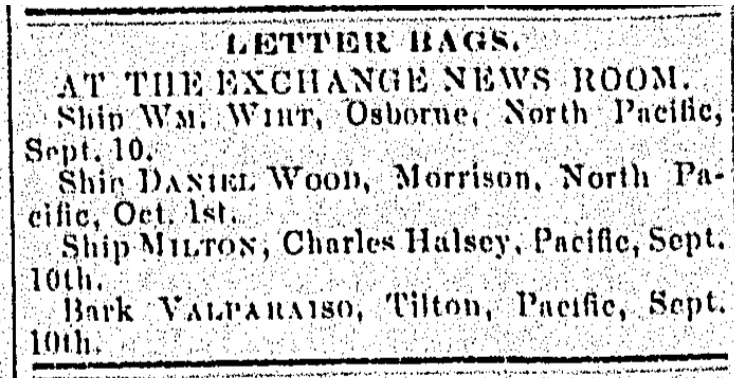
[Excerpt from the New Bedford whaling newspaper the Whalemen’s Shipping List reading: Letter Bags. At the Exchange News Room. Ship Wm. Wiht, Osborne, North Pacific, Sept. 10. Ship Daniel Wood, Morrison, North Pacific, Oct. 1st. Ship Milton, Charles Halsey, Pacific, Sept. 10th. Bark Valparaiso, Tilton, Pacific, Sept 10th.]
The Whalemen’s Shipping List came out weekly with a list of all known American whaleships at sea and when and where they were last heard from (mostly coming from letters Captains would send at port to their agents to report on their progress). I often think about someone with a loved one at sea picking up that paper every week and scanning for the name of a familiar ship only to see no change in when it was last heard from, for months at a time.
Sometimes letter drop offs were even more unofficial. On islands known by whalers for provision stops, they would simply set up a Post Office Barrel to drop letters in where other passing ships could remove the letters and leave their own. The legacy of one such barrel continues today on Floreana Island in the Galapagos. Here’s a great Atlas Obscura article on it.
With these methods it was often years before anyone received any news of each other, if the letters ended up being received at all. Still, through a community of seafaring strangers making these kind exchanges, some of those letters did find their way to their respective parties. Ives, in his diary, sent out a plea to all those who had a family member at sea to write them a letter, so great was the need.
“Speaking of letters leads me to remark that of all the people in the world, it seems to me that a sailor prizes a letter the most. Expected letters form the subject of many conversations for weeks before the ship goes into port. How many each one thinks he shall get, and who will be the writers. Speculations are rife as to the health of those from whom they are awaiting news. And if it is known that Jack, or Ben, or Dick were paying particular attentions to any certain young lady, previous to sailing, or if they are supposed to be engaged to get “spliced” when the voyage is concluded, many jokes are cracked at their expense, and numerous are the wishes of their messmates that they “may get good long ones, and chock full of love.”
As soon as the ship comes to anchor, a boat is sent for the mail, and returning as quickly as possible. Watch the various countenances as the ships company crowd aft to the quarterdeck where the mate is untying the bundle and looking over the contents. Notice how eagerly they listen as he calls the names of the fortunate ones. One fellow carries off two, another three or four or perhaps five. Some get only one but they think they are lucky to get that, while many who have been anxiously waiting and were “sure they should get one anyhow,” turn sadly away as the last name is called, hardly able to repress a tear at their bitter disappointment. Some bear the frustration of their hopes quite philosophically, and you may hear one remark “well if they won’t write to me I’ll have my revenge, I’ll write to them, and give them double measure at that.” Others feel badly enough, and make up their minds to quite writing altogether. What numberless questions are asked of each other by the owners of the precious missives. “How many did you get Dick?” “Is she well Jack?” and other like enquiries.
Many of those who sail in whale ships are young men who have parents or other relatives living in the States, and it seems to me that if they only knew how great a value their sailor boys placed upon a letter from home, they would consider it their duty to be particular in writing often, and to be sure that their letters bore the proper directions.”
With that, I will leave you with a section of a logbook where its keeper kept an itemized list of letters he received and letters he sent over the course of the voyage:
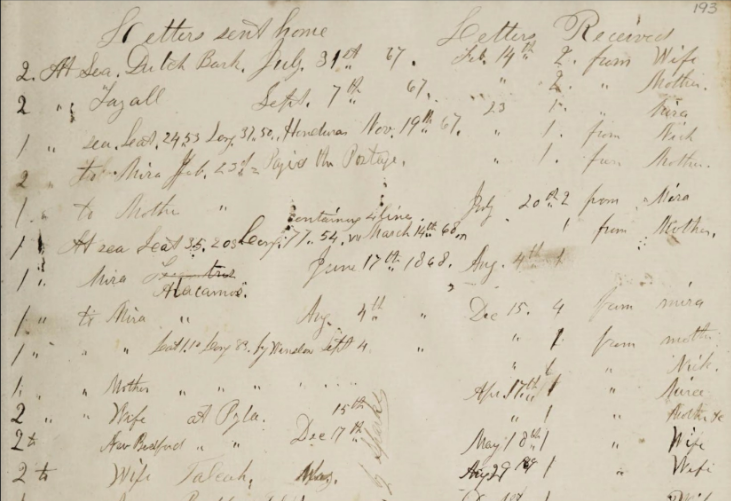
[Excerpt from a logbook listing Letters Sent Home and Letters Received, including the dates and ports they were sent from. The majority of the letters written and received come from the keeper’s wife and mother.]
Quisque iaculis facilisis lacinia. Mauris euismod pellentesque tellus sit amet mollis.